Following the Light to Skagen
- elisabeth albeck

- Sep 25, 2024
- 5 min read

Turns out that in Danish, Aalbaeck and Albeck are not the same thing. They are different words, different names, and different places.
With my limited knowledge of the Danish language, in my exuberance at discovering this seaside town, I didn't do very thorough research. Upon returning from my soul-refreshing days in Jutland, my godfather coolly explained to me that the town where our family is from long ago is an even smaller berg, a few hundred kilometers to the southwest, inland.
While it may seem disappointing, this fact didn't diminish my experience of traveling there. If nothing else, traveling to Aalbaeck is what brought me to Skagen.
Skagen is a small seaside town on the northern most tip of Jutland, where the North Sea meets the Baltic Ocean. The landscape is sandy, and the sky and ocean views are abundant in all directions. It has long been an enclave for fishermen (a fact you can even smell when you drive into town), but in the late 1800’s it also became a destination and home for artists.
There is a saying in Denmark, which is that Skagen has "the most beautiful light in the world." It is the special quality of the light there that attracted some of Scandinavia's most well-known painters to visit, live, and learn. As I came to know in my visit, some of the region's most extraordinary painters spent their formative years in that landscape. This group of artists is known as the Skagensmalerne. They formed a commune, where they could experiment together and advance modern notions of painting beyond their formal training at institutions like the Royal Danish Academy of Fine Arts in Copenhagen. They enjoyed life in Skagen, painting en plein air, and documenting intimate scenes of life there in their works.

The special magic of the city can be felt as soon as you arrive into its tangled cobblestone streets, after driving about 10 km north from Aalbaeck through an expanse of sandy grassland. The homes are classically marigold yellow, or black or red or white. The sky on the September day when I visited was a blazing, rich cerulean blue, touched by appropriately painterly soft clouds.
When I arrived, my first destination was the museum. While the painters of Skagen were previously not known to me, their works are recognizable, engrossing, and completely spectacular. Anna Ancher. Michael Ancher. Carl Madsen. Laurits Tuxen. P.S. Krøyer. These are some of Denmark's most distinguished and revered artists. As I walked through the galleries of Skagens Museum, I felt like I floated from room to room. I know I bore my astonishment on my face, my body: my mouth was, at several points, agape. Chills cascaded up and down my spine like waves, endlessly whitecapping. Each painting told a story, and the stories all took place paces away on the beach, in the dunes, in the streets of Skagen, under a special sky-- or within the kitchens, living rooms all around the Museum, with the light filtering in through windows.


I was inside the museum for only about an hour before a hunger to paint gripped me.
Strolling with my sun hat, my watercolors, my eyes, hands and my mother’s advice, I made my way to the beach on the Baltic side. I crossed a wandering sandy path through sunny dunes dense with yellowing wild rose bushes, rainbow grasses, broken white and tan seashells and warm pink stones. On the girthy beach, I sat halfway between the dunes and the shoreline. Freighter ships moved slug-like across the horizon. The sky in the distance swirled with different watery designs on the day: possible storm fronts, in the foreground, wispy white clouds, and, in between, a patch of deep blue that looked like a paintbrush had just drenched the spot with deeply pigmented phthalo blue.

I studied the colors that had inspired the painters and their incredible demonstrations, and made a few quick paintings.
I found that along the horizon the sea had a purple streak. The waves crashing close to me were not blue-green, but rather, yellow and green, and constantly changing as the sand churned inside them. I filled my little tray with sea water, and made quick studies of the ocean, the sand, the dunes, Some of them quite gestural, some of them filled with questions that my technique wasn’t prepared to answer. All of them with a slight glitter of salt crystals, and made while a warm wind tried to wrest the paper from my lap.
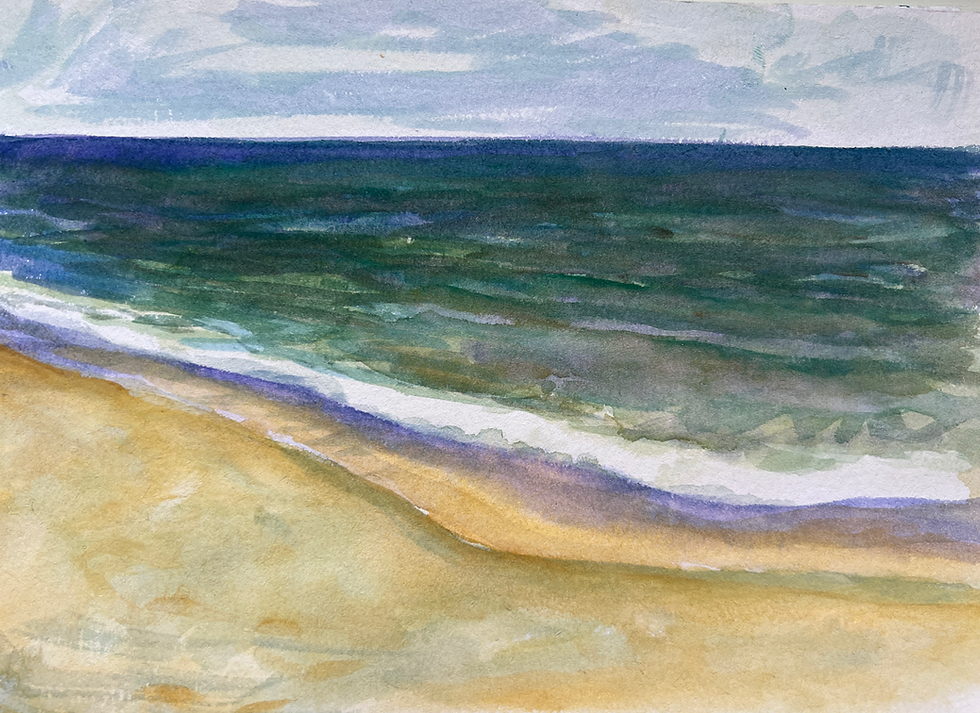
For the first time in recent memory, sitting on the beach, I felt overjoyed. There’s a special kind of giddiness in feeling like you’re exactly where you're supposed to be. It’s a privilege to be able to relax into that feeling. But after several hours painting in the sun without any sunscreen brought to re-apply, I knew I needed some shade and a meal.
I wandered from the beach into the local restaurant at Brøndum’s Hotel. Originally owned by one of the painter Anna Ancher’s father, it was a gathering place for the artists who called Skagen their home. Today, at the hotel’s restaurant one can experience the finest version of Danish dining that I've experienced, so far. Everything is served on Royal Copenhagen blue and white plates. A team of sharp, proud and starchy-uniformed waiters rush around with purpose and grace. The presentation makes you feel like a time traveler. A golden light filtered in softly through eastern windows, and the space was ethereal, cozy and warm.

For lunch I had the fish stew with fresh filets of fish (caught, again, just paces away), which was topped with dill cream and bread and butter. I also enjoyed a glass of Gruner Veltliner, one of my favorite wines from Austria. Following lunch, I treated myself to a decadent plate of chocolate petit fours filled with marzipan, jam and hazelnut.

Alone in the restaurant, I was surrounded by friends and families laughing, toasting, celebrating together. Even though I felt wistful, thinking I should have people I love with me, I also felt content. Emotions can come together and mix like waters, like colors. I felt content because in a sense, I was keeping company with the artists I had just communed with in the Museum. In reviewing the profundity of their artistic achievements-- the Anchers, for example, and imagining their lives here, I was animating their spirits anew.
While I only spent half a day in Skagen, it opened my eyes. There are so many paths that life can take us down, but it’s only possible to take one at a time. Finely tuning in to where we are in the now, what we pay the most attention to or value comes into focus. But what is true in one moment owes little allegiance to the next: through an artist’s way of seeing, it can all be experienced as revelation.
Walking, studying, and nourishing myself in Skagen that day, I heard echoes from the past and the future. To build a life around creative practice is a calling that will only keep calling. I'm here now to listen, to notice, to learn and soak up everything. This is my practice.


Comments